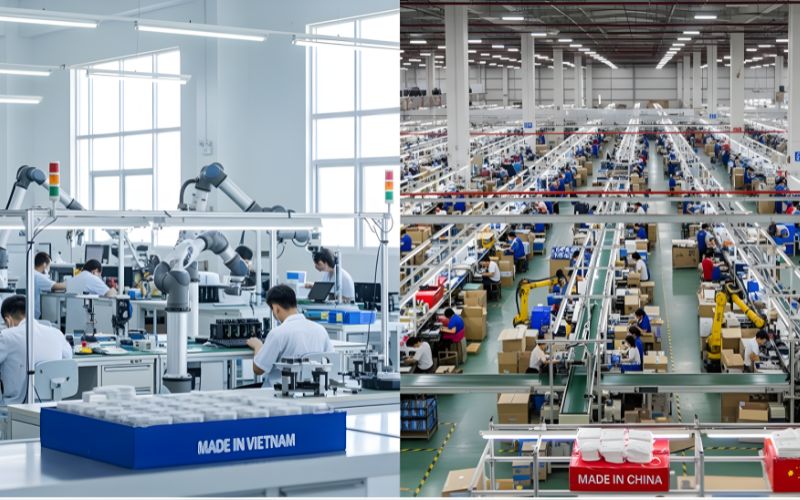
The end of “China-only manufacturing”
For more than two decades, China was the undisputed center of global manufacturing. Its scale, infrastructure, supplier density, and labor force made it the top choice for companies seeking efficiency and cost optimization. Entire global value chains were built on the assumption that China would remain the world’s factory indefinitely. That assumption no longer holds.
Since the late 2010s, and decisively after the COVID-19 pandemic, manufacturing strategies centered exclusively on China have been exposed as fragile. Rising labor costs, geopolitical tensions, export controls, tariffs, regulatory uncertainty, and operational disruptions have forced companies to rethink how and where they produce. The question is no longer ideological, nor driven by short-term cost arbitrage. It has become a strategic discussion about resilience, risk management, and long-term competitiveness.
In this context, the Vietnam vs China manufacturing debate has moved to the top of boardroom agendas. Vietnam is no longer perceived as a peripheral alternative, but as a central pillar in Asia-based diversification strategies. At the same time, China remains unmatched in many industrial segments, making the decision far more complex than a simple relocation.
This article offers a grounded, reality-based manufacturing comparison in Asia, focusing on Vietnam and China. It examines what truly matters for decision-makers: cost structure, supply-chain depth, operational risk, execution capability, and strategic fit.
Cost Reality: Labor is no longer the whole story
Labor cost is often the first variable cited in any Vietnam vs China manufacturing discussion. On paper, the gap remains significant, but focusing solely on wages obscures the deeper cost structure that companies actually face.
As of 2024–2025 estimates, average monthly manufacturing wages in Vietnam range between USD 280 and 350, depending on region and skill level. In contrast, wages in coastal China typically fall between USD 650 – 900, excluding overtime premiums and indirect labor costs. This differential is real and meaningful, especially for labor-intensive industries such as apparel, furniture, and consumer goods.
However, labor cost alone no longer defines competitiveness. In China, rising social contributions, stricter labor compliance, and higher turnover in coastal industrial zones have added layers of indirect cost. These include recruitment cycles, training expenses, and production disruptions linked to workforce mobility. Vietnam, while experiencing wage inflation of its own, still offers a more predictable labor cost trajectory and lower ancillary charges in most industrial regions.
Equally important is productivity. Vietnam’s manufacturing productivity has improved steadily over the past decade, supported by foreign direct investment, technology transfer, and exposure to international quality standards. In assembly-based and mid-value manufacturing, the cost-to-output ratio in Vietnam has become increasingly competitive, even when China retains higher absolute efficiency.
Crucially, companies that reduce the comparison to wage tables alone often miscalculate total landed cost. Energy pricing, tax incentives, logistics, compliance costs, and risk premiums now weigh as heavily as hourly labor rates.
Supply Chain Depth: China is complete, Vietnam is selective

China’s core strength remains its unparalleled supply-chain depth. In many sectors, raw materials, components, tooling, processing, assembly, packaging, and logistics are available within a single industrial radius. This density allows for rapid iteration, tight coordination, and minimal dependency on cross-border sourcing.
Vietnam operates differently. Vietnamese manufacturing supply chains are highly efficient but more segmented. In sectors such as textiles, footwear, furniture, and electronics assembly, local ecosystems are robust and export-ready. However, upstream inputs, advanced materials, specialized components and high-precision tooling are still frequently imported, often from China, South Korea, or Japan.
This does not represent a weakness per se, but a structural reality. Vietnam’s manufacturing model is optimized for assembly, processing, and export, rather than full vertical integration. For companies with clear bills of materials and stable designs, this structure works efficiently. For projects requiring constant redesign, rapid prototyping, or deep upstream engineering, China retains an advantage.
The strategic implication is clear: Vietnam excels when production can be planned, standardized, and scaled with discipline. China remains superior for complex, highly iterative manufacturing environments.
Understanding this distinction is central to any serious manufacturing comparison in Asia.
Risk & geopolitics: why diversification is no longer optional
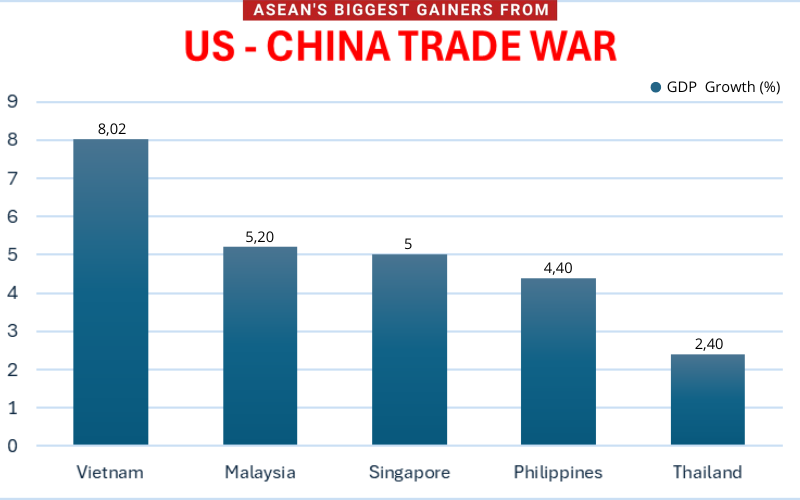
Risk has moved from the margins of manufacturing strategy to its core. Over the past five years, companies manufacturing exclusively in China have faced compounding risks: tariffs imposed during the US-China trade conflict, export controls on advanced technologies, regulatory unpredictability, and geopolitical pressure affecting customer perception and market access.
While Vietnam still faces infrastructure and skilled labor constraints in certain sectors, its geopolitical positioning and trade integration offer a different and often complementary risk profile to China. The country maintains broad trade neutrality, strong diplomatic relations with the United States, the European Union, and regional partners, and is deeply integrated into multilateral trade frameworks. Free trade agreements such as the EVFTA and CPTPP provide preferential access to key markets, reducing tariff exposure and improving long-term predictability.
Importantly, Vietnam is not positioned as a replacement for China, but as a risk-mitigation platform. Companies that adopt a China-plus-one or China-plus-multiple strategy reduce single-country exposure without dismantling existing ecosystems.
In practical terms, this diversification lowers geopolitical concentration risk, improves supply continuity, and strengthens negotiation leverage across suppliers.
Operational reality: speed, reliability, execution
Operational execution is where many Vietnam-China comparisons become distorted.
China remains extremely fast at industrial execution. Decades of manufacturing experience have created a culture of responsiveness, engineering improvisation, and rapid scale-up. For companies operating under tight development cycles, this capability remains valuable.
Vietnam’s execution model is more structured. Production ramp-up often requires more upfront planning, clearer documentation, and closer on-site supervision during early phases. This does not indicate lower capability, but a different operational rhythm. Once stabilized, Vietnamese factories deliver strong consistency, quality adherence, and export compliance. However, companies that underestimate the importance of process definition, quality monitoring, and local presence often encounter delays or variability in early production stages. The most successful projects in Vietnam are those managed with realistic timelines, pilot phases, and structured supplier engagement. When these conditions are met, operational reliability becomes a strength rather than a constraint.
Manufacturing comparison Asia: why Vietnam stands out
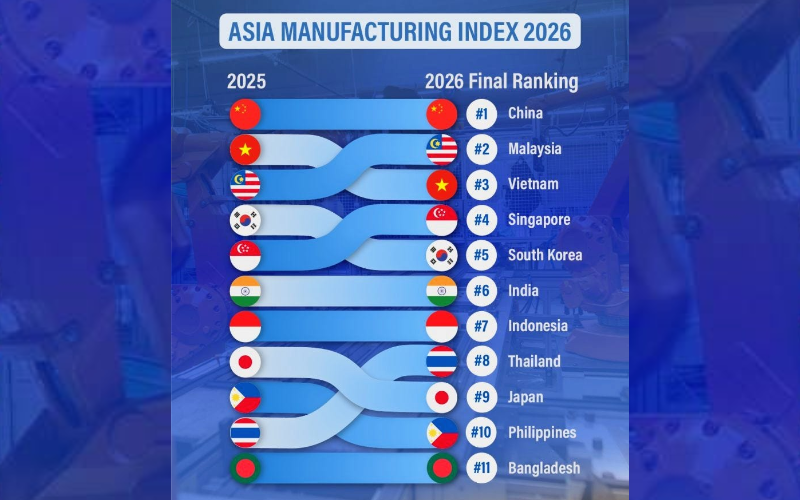
Within Southeast Asia, Vietnam has emerged as the most balanced manufacturing destination for export-oriented industries. Unlike some regional peers, Vietnam combines competitive labor costs, political stability, large-scale industrial zones, and deep integration into global trade frameworks.
Indonesia offers scale but faces regulatory complexity. Thailand provides advanced capabilities but at higher cost. Malaysia excels in electronics but with a smaller labor pool. Vietnam occupies a strategic middle ground, making it the default choice for companies seeking diversification without sacrificing operational maturity.
This is why Vietnam now plays a central role in manufacturing comparison Asia discussions. It is not the cheapest destination, nor the most vertically integrated, but it offers a rare equilibrium between cost efficiency, scalability, and risk control.
Conclusion: Choosing Vietnam is a strategy, not a shortcut
The Vietnam vs China manufacturing debate cannot be reduced to a binary choice. China remains indispensable for certain industries, particularly those requiring deep vertical integration, advanced engineering, or rapid product iteration. Vietnam, by contrast, excels as a strategic manufacturing platform for standardized, export-oriented production where cost control, geopolitical resilience, and long-term predictability matter most.
The companies that succeed are not those that abandon China entirely, but those that redesign their supply chains with intention. Vietnam is not a shortcut to cheaper manufacturing. It is a strategic lever for diversification, resilience, and sustainable growth.
In a world where supply-chain risk is no longer theoretical,Vietnam has firmly established itself as a key pillar of modern manufacturing strategies in Asia.